

Food Poisoning in Tangier: What to Do and When to Get Seen
Most food poisoning settles on its own within one to three days. The real risk is not the germ — it is fluid loss.
Written by Dr Mehdi El Amrani
Gastroenterology and emergencies — Enurgence
Medically reviewed by Dr Karim Bennani
Published
Last medically reviewed

Food poisoning shows up within hours of a meal as nausea, vomiting, cramps and diarrhoea. In the large majority of cases it settles on its own in one to three days and needs nothing more than careful rehydration. The danger is not the organism — it is dehydration. Get medical advice without delay if there is blood in the stool, a persistent high fever, a complete inability to keep fluids down, or if the person is an infant, elderly, pregnant or immunosuppressed.
How do you recognise it?
Symptoms usually start between one hour and three days after the meal responsible, depending on the organism or toxin: nausea, vomiting, abdominal cramps, watery diarrhoea, sometimes a moderate fever and aching.
A useful clue: if several people who shared the same meal fall ill at roughly the same time, food is almost certainly the source.
What to do in the first hours
- Rehydrate in small amounts. A few sips every 5 to 10 minutes stay down better than a full glass, especially while vomiting. Water, salted broth, diluted flat soft drinks.
- Use oral rehydration salts if you have them, particularly for children and older people. They are the reference treatment for acute diarrhoea; dissolve the sachet in the full volume of water stated, not less.
- Eat as soon as you can tolerate it. Rice, bread, banana, potato, cooked carrot. There is no benefit in fasting.
- Skip alcohol, coffee and fatty food until stools are back to normal.
The main risk is dehydration. If you can no longer keep fluids down, a doctor can examine you on the spot in Tangier. 06 64 54 84 12
Anti-diarrhoeals and antibiotics: yes or no?
A transit slower such as loperamide can relieve troublesome diarrhoea in adults, but it is not advised with a high fever or blood in the stool: slowing the gut then prolongs contact with the organism. It is not recommended in young children.
Antibiotics are not the standard treatment. Most episodes are viral or toxin-mediated, and antibiotics taken unnecessarily can prolong bacterial carriage while driving resistance. Whether they are indicated is decided after an examination, on specific grounds.
Which signs mean being seen without delay?
- Blood or mucus in the stool.
- Fever above 39 °C, or a fever lasting beyond 48 hours.
- Unstoppable vomiting: nothing stays down for more than 6 to 8 hours.
- Signs of dehydration: dry mouth, no urine for 8 hours or more, very dark urine, dizziness on standing, drowsiness.
- Severe, localised abdominal pain that builds rather than easing after a bowel movement.
- Infants, older adults, pregnancy, diabetes, kidney failure, immunosuppressive treatment.
- Neurological symptoms after a meal — double vision, muscle weakness, pins and needles. That is an emergency: call 15.
What a doctor can do on site, and what they cannot
At your accommodation, a doctor can assess hydration, take your blood pressure, examine the abdomen to rule out a surgical cause, give an injectable anti-sickness drug when vomiting blocks all rehydration, set up a drip for moderate dehydration, and prescribe what follows.
Severe dehydration, suspected appendicitis or obstruction, or a need for urgent tests belong in hospital. One concrete purpose of an examination on the spot is precisely to decide whether you need to go.
Reducing the risk in Tangier
The measures that genuinely matter: sealed bottled or treated water, caution with ice of unknown origin, fruit you peel yourself, food served piping hot rather than lukewarm, and wariness of dairy or raw-egg preparations that have sat out at ambient temperature — a real factor in summer.
When can you travel or go back to work?
In practice: once fluids stay down, the fever has gone and stools are spacing out. Food handlers and healthcare workers are usually asked to wait an additional period after symptoms stop.
Frequently asked questions
How long does food poisoning last?
Usually one to three days. Tiredness and an unsettled gut can linger a few days more, which is normal.
Should you stop eating?
No. Prolonged fasting does not speed recovery. Go back to simple foods in small amounts as soon as you tolerate them.
Can a doctor come to my hotel?
Yes, in-room consultations are possible in Tangier, including in short-term rentals. An invoice is issued at the end of the visit, which you can use with travel insurance.
When should I go straight to hospital?
With severe, continuous abdominal pain, blood in the stool alongside a high fever, marked drowsiness, or dehydration that does not correct despite attempts to drink.
Medical references
- Food safety — fact sheet — Organisation mondiale de la santé (OMS)
- Food poisoning — NHS (Royaume-Uni)
- Travelers' diarrhea — CDC Travelers’ Health (États-Unis)
- Diarrhoeal disease — fact sheet — Organisation mondiale de la santé (OMS)
Vomiting or diarrhoea that won’t settle?
The main risk is dehydration. If you can no longer keep fluids down, a doctor can examine you on the spot in Tangier.
More on this topic: digestive problems · home doctor in Tangier · our medical team
Related articles

Hotel & Airbnb Doctor in Tangier – 24/7 Room Visits
Don't let illness ruin your vacation. We send a doctor directly to your hotel room or Airbnb in Tangier 24/7.
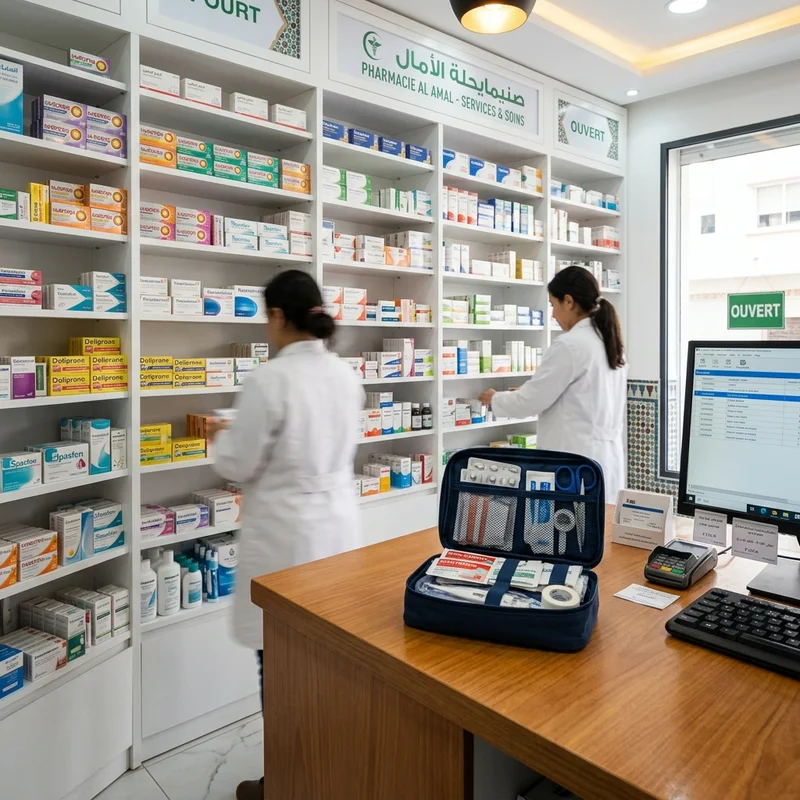
Travel Medical Kit for Morocco: The Complete Medication Checklist
What to pack in your travel medical kit for Morocco? Complete medication list, Moroccan equivalents, and tips from our emergency doctors.

Dehydration: How to Spot It in Adults and Children
Thirst is not the test. Three simple things tell you where someone stands: urine, mucous membranes, and alertness.